
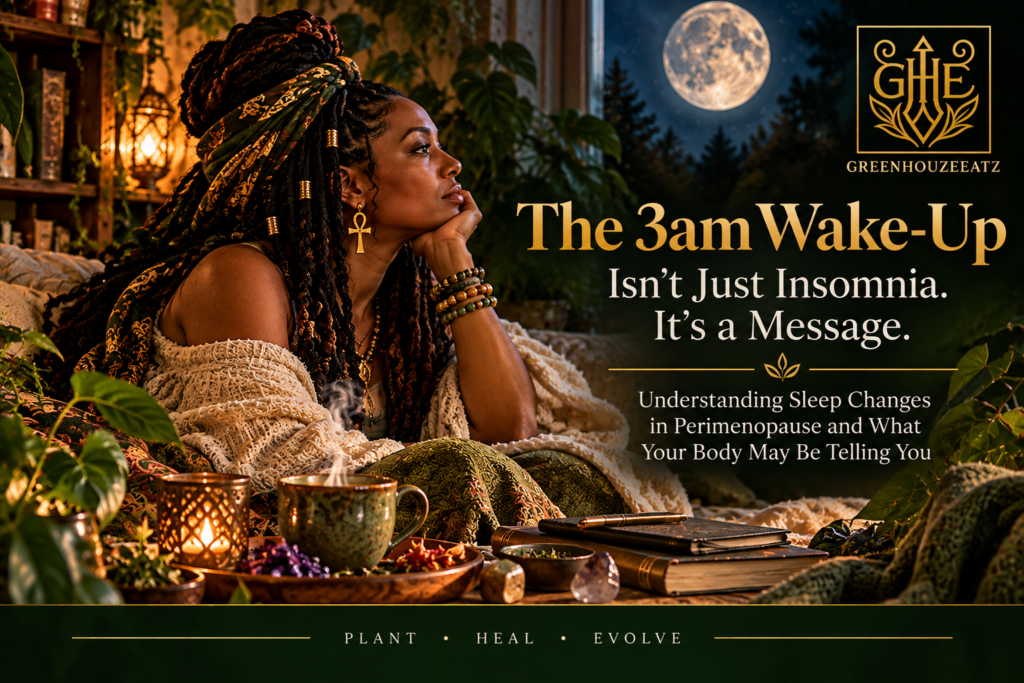
What perimenopause sleep disruption is really telling you — and a holistic protocol for deeper rest
You went to bed fine. Maybe even tired.
But somewhere between 1 and 4am, something pulled you out of sleep. No alarm. No noise. Just your eyes, open, heart sometimes racing, body sometimes drenched, mind immediately spinning into everything you need to do or everything you’ve done wrong.
And then — the worst part — you couldn’t go back.
If this is your reality right now, I want you to hear this: your body is not punishing you. It is communicating with you through the only window you can’t scroll away from.
Why 3am? The Science and the Spirit
Through the lens of Traditional Chinese Medicine, the hours between 1am and 3am belong to the Liver meridian. That is an energetic system, not the anatomical organ, tied to emotion and the smooth flow of qi, or life energy. In this framework, waking in this window can point to liver qi stagnation: held grief, unexpressed anger, a life that needs to move. That is a traditional map of meaning, not a lab finding, and many women find it a useful way to listen.
From a Western physiology lens, perimenopausal sleep disruption has several overlapping drivers. Night sweats and hot flashes wake many women. Falling progesterone matters too, because its byproducts help calm the brain through the same receptors (GABA) that many sleep medications target. Fluctuating estrogen affects temperature regulation and sleep depth. Stress, mood, and nighttime arousal play a role, and so do things that become more common in midlife, like sleep apnea.
These two frameworks speak different languages, and I won’t pretend they are the same thing. But they agree on one point: this waking deserves to be taken seriously, not just endured. Something wants your attention.
What Makes It Worse
- Alcohol — it may help you fall asleep, but it tends to fragment the second half of the night and can trigger hot flashes in some women
- Large or late meals — can bring reflux and restlessness for some people
- Ongoing stress — a body on high alert has a harder time settling back down once it wakes
- Bright light and screens late into the evening — can delay your body clock and make it harder to wind down
- Caffeine later in the day — some women are more sensitive to it in this season
- Low magnesium intake — many people get less from food than recommended, and it supports muscle relaxation and nervous system function (food sources below)
The Holistic Sleep Protocol
The Evening Ritual (begins at 8pm)
- Dim the overhead lights. Lamp or candle only by 9pm (and never leave a candle unattended).
- Magnesium-rich foods in the evening — a small handful of pumpkin seeds (about 156 mg per ounce) or black beans or edamame with dinner (about 60 mg and 50 mg per half cup).
- A warm, caffeine-free herbal tea as your wind-down signal. Chamomile or lemon balm are gentle, widely used choices. Stronger sedating herbs like valerian and passionflower are best used with your clinician’s input, especially with sedatives or other medications.
- 10 minutes of legs-up-the-wall (Viparita Karani) — many women find it deeply calming. Skip or modify it if you have glaucoma, uncontrolled high blood pressure, or acid reflux.
- Try to finish your last full meal two to three hours before bed. If you’re hungry, a small plant-based snack (banana with almond butter, a bowl of oats) beats lying awake hungry.
A Word on Magnesium Supplements
Food comes first. If you’re curious about a supplement, talk with your clinician or pharmacist. The upper limit for supplemental magnesium is 350 mg a day, it can cause loose stools, it isn’t right for everyone with kidney problems, and it can interact with some antibiotics, osteoporosis medications, and diuretics. Evidence that it improves sleep is limited, so treat it as an experiment, not a fix.
If You Wake at 3am
- Keep the phone down. The light and the scroll wake your brain up and make it harder to drift back.
- Put one hand on your heart, one on your belly. Take four slow breaths, making the exhale longer than the inhale.
- If it feels safe, ask: What am I carrying that needs to be set down? If that question feels like too much at 3am, skip it and orient instead: name three things you can see, hear, or feel.
- If you don’t fall back asleep in about 20 minutes, get up. Do something quiet and non-stimulating in low light. Return when you feel sleepy — not tired. Sleepy.
Morning After Protocol
- Get outside in daylight within the first hour or so of waking. Light reaching your eyes helps anchor your body clock for the next night’s sleep.
- Keep caffeine to the morning (many women do better with a cutoff around noon), and notice whether it feeds your night sweats or wake-ups.
- Protein at breakfast — tofu scramble, lentils, chia pudding with soy yogurt, or oats with hemp seeds — supports steady energy and fullness.
The Ancestral Practice
Some Indigenous and African-rooted traditions did not pathologize nighttime waking. The night was a different kind of time — when the veil between worlds thinned, when ancestors communicated, when the body processed what daylight couldn’t hold. That is a spiritual perspective, offered here as a practice, not as a scientific claim.
If you find yourself awake at the same hour often, consider keeping a small journal by the bed. Not for to-do lists. For what comes through when everything else is quiet. Keep the lights low.
Many of our grandmothers were not scrolling through WebMD at 3am. They were praying. Lighting a candle. Listening. There is something to that.
“The GreenHouze is maintained in the dark just as much as in the light. What grows in you at 3am is not a problem to fix — it is a root deepening.” — Mecca Lee
When It’s More Than a Season
Talk with your clinician if sleep trouble shows up three or more nights a week for a month or longer, if you snore loudly or wake gasping (sleep apnea becomes more common in midlife), if night sweats are soaking your sheets, or if early-morning waking comes with a low or anxious mood. Cognitive behavioral therapy for insomnia (CBT-I) is the best-studied first-line treatment for ongoing insomnia, and hormone therapy can help when night sweats are the culprit. Getting help is not a detour from the holistic path. It is part of it.
Your Soil Amendment This Week
- Add one magnesium-rich food to tonight’s plate — pumpkin seeds, black beans, spinach, or almonds. Tonight, not tomorrow.
- Create one non-negotiable wind-down signal (tea, dim lights, off the phone). One.
- When you wake at 3am, try the breathwork before the doom scroll. Every time.
Sleep is not a luxury in perimenopause. It is the foundation of every other system. Hormones, mood, metabolism, immunity — all of it leans on good rest.
Protect it like the sacred infrastructure it is.
Tending note. This is education, not diagnosis or treatment. Herbs and supplements can interact with medications and aren’t right for everyone, especially in pregnancy or with a hormone-sensitive, liver, kidney, or thyroid condition. Check with your clinician or pharmacist first.
— Mecca Lee | GreenHouzeEatz | Plant • Heal • Evolve