
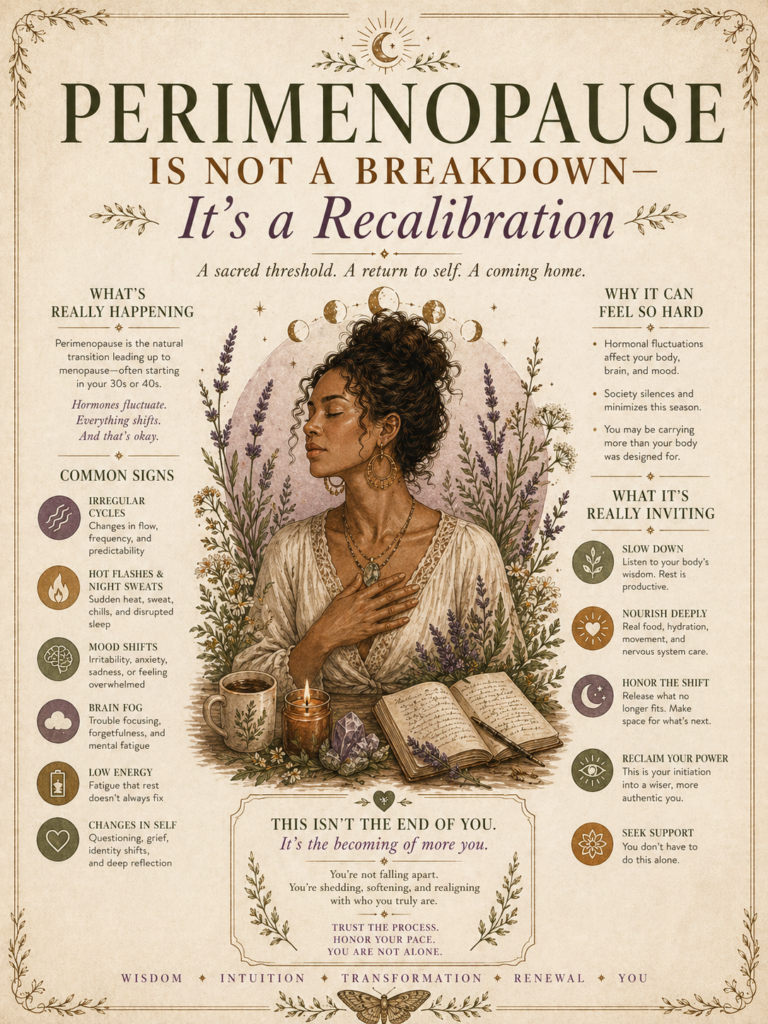
The GreenHouzeEatz lens on perimenopause, nervous system shifts, and what your ancestors already knew
Let’s start with what nobody tells you.
Perimenopause isn’t a malfunction. It isn’t the beginning of your decline. It isn’t your hormones “going crazy” or your body betraying you after decades of loyalty.
It is a pruning. A controlled burn. A seasonal transition that your lineage has moved through for generations — without a diagnosis, and without the shame that modern wellness culture has quietly stitched into the conversation.
What you are experiencing is real. The heat that rises without warning. The sleep that used to come easily and now arrives in fragments. The irritability that feels too big for the situation. The brain that reaches for a word and finds fog instead.
Real. All of it.
But real doesn’t mean wrong. And that distinction is everything.
What’s Actually Happening in the Body
Perimenopause — the transitional phase that most often begins in your 40s, sometimes earlier, and commonly lasts several years — is marked by fluctuating estrogen and progesterone levels as your ovaries begin to shift production. These aren’t just reproductive hormones. They are nervous system regulators, mood modulators, anti-inflammatory agents, and sleep architects.
When they fluctuate — and they fluctuate unpredictably, not in a clean linear decline — your entire system feels it. Your HPA axis (your stress response center) becomes more reactive. Your gut microbiome shifts. Your thermal regulation gets disrupted. Your amygdala, the part of the brain that processes threat and emotion, becomes more sensitive.
This is why perimenopause can look like anxiety, burnout, chronic stress, or trauma response — even when nothing “bad” is happening in your life.
Your nervous system is reorganizing. It needs support — and sometimes that support includes medical care.
The Ancestral Lens
In many West African and Diasporic traditions, this phase of a woman’s life was not a medical event. It was a threshold. A passing from one role into another — from the woman who gives life to the woman who holds wisdom. From the one who tends the fire to the one who becomes it.
Elders were revered. The shift out of cyclical bleeding was understood as a gathering of power, not a loss of it. The hot flashes? Some traditions described them as the body releasing what it no longer needed to carry. The emotional amplification? Evidence that your discernment was sharpening.
This is a cultural and spiritual lens, not a medical explanation, and it doesn’t replace the science above. It sits beside it. That framing doesn’t erase the discomfort. But it gives it meaning. And meaning is medicine.
What the Plants Say
Plant medicine has a long history in women’s hormonal transitions. History isn’t proof of effect, and “natural” doesn’t automatically mean safe. So here is each ally in three honest layers: tradition, research, and what to check first.
- Black Cohosh — Tradition: hot flashes and night sweats. Research: mixed; some studies show fewer hot flashes, none show a mood benefit. Check first: liver conditions (rare liver injury has been reported), hormone-sensitive conditions, pregnancy, medications.
- Vitex (Chaste Tree Berry) — Tradition: cycle-related symptoms. Research: mostly studied for PMS; limited for perimenopause. Check first: hormonal birth control or hormone therapy, dopamine-related medications, hormone-sensitive conditions, pregnancy.
- Ashwagandha — Tradition: an Ayurvedic tonic for stress and vitality. Research: some trials show lower stress and anxiety scores over weeks. Check first: thyroid conditions or medication, liver conditions, autoimmune conditions, sedatives, pregnancy.
- Maca Root — Tradition: an Andean vitality root. Research: small studies suggest possible benefit for sexual function; effects on hormones are inconsistent. Check first: hormone-sensitive conditions, blood pressure medications, pregnancy.
- Red Clover — Tradition: a women’s tonic. Research: isoflavones with weak estrogen-like activity; hot flash trials are mixed. Check first: hormone-sensitive conditions, blood thinners, pregnancy. Long-term safety is unknown.
Herbal support is not one-size-fits-all, and no herb has been shown to work as reliably as medical options. Bring your whole list to your clinician or pharmacist, and try one thing at a time.
The Nervous System Protocol Nobody Is Talking About
Here is something most perimenopause content skips: one of the most accessible things you can do during this transition is support your nervous system daily. Not once a week in a yoga class. Daily.
Hormonal shifts can influence the balance between your stress response and your rest-and-digest response, which includes the vagus nerve, often called the body’s internal calm switch. Practices that activate the parasympathetic response become non-negotiable:
- Slow, extended exhales (longer out-breath than in-breath signals safety to the nervous system)
- Humming, chanting, singing — vibration in the throat may stimulate the vagus nerve
- Cold water on the face or neck — can briefly slow the heart rate (the dive reflex). Skip it with a heart condition or arrhythmia, and ease off if cold feels activating
- Somatic shaking (neurogenic tremor) — many people find it releases tension; research is early, so go gently and stop if you feel dizzy, flooded, or disconnected, especially if you’re healing from trauma
- Morning daylight — time outside early in the day, with light reaching your eyes (never stare at the sun), helps anchor your body clock and supports sleep and mood
These practices support stress regulation and wellbeing. They haven’t been shown to stop hot flashes themselves. For that, medical options exist (below).
The GreenHouze isn’t a place you escape to — it’s the body you return to. Perimenopause is an invitation back inside.
Mecca Lee
The Soil Amendment
If you’re in the thick of perimenopause right now, here’s your starting point:
- Normalize what’s biological. This transition is a normal part of life, and you still deserve care when symptoms disrupt it.
- Add one nervous system practice daily — even three minutes counts.
- Lean toward whole, plant-forward foods and ease back on added sugar, alcohol, and ultra-processed foods, which can worsen sleep, energy, and for some women, hot flashes.
- Add phytoestrogenic foods: flaxseed, edamame, tempeh, sesame seeds, dried apricots.
- Build an ancestor relationship with this transition. Ask: who came before me through this? What did they know?
Know When to Call for Backup
Tending yourself includes knowing when to bring in support. Reach out to a clinician if:
- Your bleeding is very heavy, lasts longer than seven days, comes more often than every 21 days, or appears between periods or after sex
- Hot flashes, night sweats, poor sleep, or mood changes are disrupting your work, relationships, or quality of life
- Your mood feels dark, hopeless, or out of control
- You are under 40 and your periods are becoming irregular
For many women, menopausal hormone therapy is the most effective treatment for hot flashes and night sweats, and there are non-hormonal prescription options too. Whether they fit depends on your age, health history, and goals. That conversation isn’t a failure of holistic care. The strongest healing is often integrated.
You are not at the end of something. You are at the threshold of something that requires a completely different kind of tending.
Let’s tend it right.
This is education, not diagnosis or treatment. Herbs and supplements can interact with medications and aren’t right for everyone, especially in pregnancy or with a hormone-sensitive, liver, kidney, or thyroid condition. Check with your clinician or pharmacist first.
— Mecca Lee | GreenHouzeEatz | Plant • Heal • Evolve